
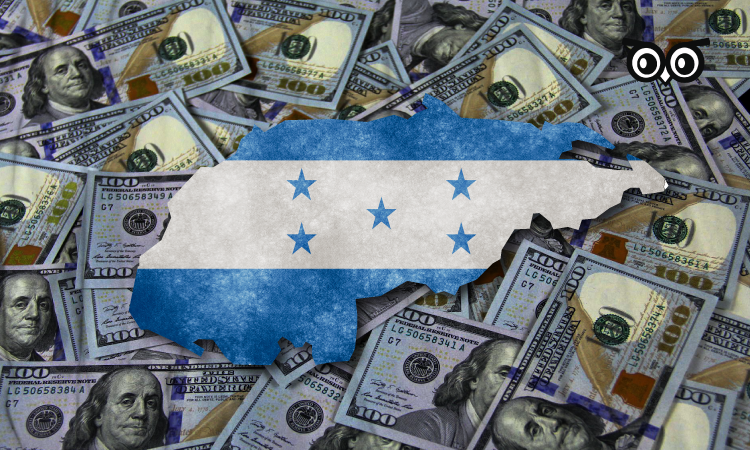
Note: Read our investigation on dollarization in Latin America to learn more about the dos and don’ts of this monetary policy and the past experiences in the region: “Dollarization Compared: Ecuador, El Salvador, Panama,” by Paz Gómez.
The same few lempiras that once paid for the morning bus ride and a warm baleada now barely cover one or the other. Since 1990, the US dollar has become 500 percent more expensive when buying with lempiras. In July 2025, the exchange rate reached 26 lempiras per dollar.
Henry Rodríguez—an economist and professor at the National Autonomous University of Honduras—warns this trend is eroding Hondurans’ purchasing power: “Inflation is heading upward; the exchange rate is shooting up; and banks adjust interest rates to the signals the economy is giving.”
For many, the question is no longer whether the dollar will dominate daily life. Rather, dollarization is occurring on a de facto basis. Rentals, real estate, and even business contracts are increasingly priced in dollars. As José Castañeda, president of the Honduran SME Federation, asserts: “The Honduran economy is already dollarized in practice.”
How can Honduras harness the development potential of dollarization to put development into hyperdrive? The key will be the right added ingredients.

Why Dollarization Is on the Table
Dollarization is not a theoretical debate. It is a response to the growing crisis of currency credibility and a chronic shortage of foreign exchange. According to the US State Department’s “2024 Investment Climate Statements,” investors in Honduras are experiencing difficulties with accessing dollars. Of the surveyed Honduran firms, 65 percent reported they are struggling to pay importers and foreign suppliers.
Further, Honduras relies heavily on remittances to supply foreign currency. Between January and May 2025, Honduran households received $4.66 billion in remittances, an increase of 20.5 percent over the same period of the previous year. Four out of five dollars come from the United States, where nearly 1.8 million Hondurans reside. For one in four Honduran households, remittances are a lifeline, and for 10 percent, they are the main source of income.
Despite this inflow, foreign reserves held by the Central Bank of Honduras stood at only $9 billion by mid-2025, compared to Guatemala’s $27 billion. With a debt-to-GDP ratio of 40 percent and a fiscal deficit of nearly 2 percent of GDP, Honduras has little room to maneuver if confidence in the lempira continues to erode.
Lessons from the Region
Honduras would not be alone in considering dollarization. Ecuador, El Salvador, and Panama each adopted the dollar for different reasons, with mixed results.
In Panama, for instance, dollarization was part of nation building and canal trade. Then strong property rights and trade openness turned stability into prosperity. Today, its banking system is one of the deepest in the region, with deposits equal to 117 percent of GDP.
In the 1990s, Ecuador faced a banking collapse and annual inflation above 100 percent. The US dollar—adopted in 2000—ended inflation and strengthened the financial sector. However, the lack of economic and fiscal reform cannibalized the dollarization’s potential and left financial depth at 37 percent of GDP.
Dollarization could anchor price stability, lower interest rates, and protect savings in Honduras. It could also ease currency shortages already disrupting businesses.
Changing the currency, however, will not solve structural problems: low productivity, corruption, weak rule of law, and poor public services. As Mario Palma, a researcher at the Social Forum on Debt and Development of Honduras (FOSDEH) argues: “the problem of the national economy is structural … regardless of the currency you use.”
Gabriella Calderón, an Ecuadorian economist and dollarization advocate, acknowledges: “dollarization is not a panacea.” However, she explains that it at least confines governments to spending only what they collect or borrow, removing the temptation to print money.
Dollarization Is Just One Step
As Argentine economist Ricardo López Murphy explains: “Dollarization must be accompanied by fiscal reform, labor reform, and recovery of investment grade [ratings].” Without those pillars, an anchor currency cannot deliver its full potential.
Honduras is at a crossroads. The lempira’s steady decline shows no sign of stopping. Remittances and reserves provide some respite, but without decisive reforms, Honduras is on borrowed time. The nation risks sliding further into a cycle of devaluation, shortages, and uncertainty.The choice is not between dollarization or reform. The Central American country would benefit from both. Adopting the dollar would provide stability, but meaningful prosperity will only follow if Honduras uses that stability to build stronger institutions, enforce fiscal discipline, and open its economy to investment.

