
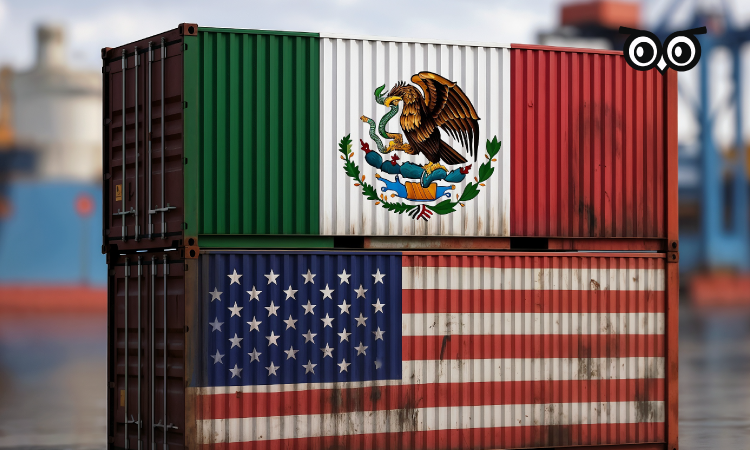
The United States-Mexico-Canada Agreement (USMCA) is less than a year away from a review. With US President Donald Trump likely to demand an overhaul, the temperature is rising. In September, all three participating nations began public consultations.
Mexico must be proactive. She has a lot to lose if USMCA negotiations go sour, but the right priorities and strategy promise a fruitful outcome for many years to come. Mexican President Claudia Sheinbaum would best sideline her ego and prioritize economic rationale.
Like Canada, Mexico is in a weak negotiating position. More than 80 percent of Mexican exports go to the United States. Remittances across the Rio Grande are 4 percent of GDP and surpass agricultural exports. The United States could inflict plenty of pain on Mexico, but the inverse is not the case.
Trade agreements rarely fit the free-trade moniker, given their complexity, favoritism, and central planning. The original North American Free Trade Agreement (NAFTA) and the USMCA are about 1,200 pages. However, trade agreements have facilitated more trade rather than less and enabled meaningful development.
An agreement can achieve two key outcomes: (1) fewer and lower barriers to trade and (2) regulatory harmonization, including independent arbitration. Rather than progressive social causes—such as environmentalism and gender ideology—these two outcomes would best remain Mexico’s priority.
US demands might actually be a healthy catalyst for Mexico, as they have been for Canada. Without US pressure, for example, Canada is unlikely to dismantle her Soviet-style supply management system for dairy, eggs, and poultry.
For less developed economies, harmonization can integrate better-functioning institutions. For example, streamlining Mexico’s financial markets with Canadian or US markets for unimpeded access to Anglo-American capital would be a boon for Mexico.
Assuming inertia and certainty, trade agreements can enable long-term planning. This is where the Trump administration is generating headaches, given the cloud hanging over the USMCA and its vulnerability to populism.

There is time to rally Mexico’s troops before negotiations in July 2026. Here are three ways to strengthen Mexico’s position and limit the potential damage:
1. Pick the right ally: the United States and not the Chinese Communist Party. The guiding priority of Trump’s trade strategy is the geopolitical power struggle with China, towards a US-centric Transatlantic trade bloc. Any alignment with China from Mexico is a recipe for White House retaliation.
The Morena coalition under Sheinbaum is not an ideological ally of America-first. However, siding with China, Cuba, and other authoritarian states is a suicide mission. Diplomatic gestures and a collaborative approach would cultivate goodwill before parties meet and reduce the likelihood of a vengeful Trumpster outburst.
2. Diversify your economy to be more lucrative to US entrepreneurs. If you have little to offer and cannot walk away, you have held yourself hostage and cannot negotiate.
Mexico has, in the NAFTA-USMCA era, made positive strides towards diversification. However, as Research Director Paz Gómez recently wrote, “When Mexico faced a nearshoring boom that could have transformed its economy, Sheinbaum’s administration doubled down on paternalism and centralized control.”
Simple changes would work wonders. For example, under President Andrés Manuel López Obrador (2018–2024), Mexico approved zero mining concessions. This lose-lose policy has narrowed opportunities and made Mexico less attractive.
3. Cultivate other trading partners such as Brazil, the European Union, and Japan. As noted by former Canadian Ambassador to Mexico Graeme Clark on the 35 West podcast, focusing so much on the United States, while neglecting bilateral opportunities, has emboldened US officials.
Mexico need not be passive, and there are many ways to propagate trade relationships and bring competition upon US enterprises. The Comprehensive and Progressive Agreement for Trans-Pacific Partnership (CPTPP) is a starting point. This healthy counterweight includes Australia, New Zealand, and Singapore, and it offers low-hanging fruit for cuts to trade impediments.
There is no getting around the fact that the United States has economic might and is a valuable trading partner, both for Canada and Mexico. USMCA stability is an important part of those relationships. The choice of a win-win deal revision in 2026 is available to the Mexican president, assuming she is willing to get past ideological loyalties.

