
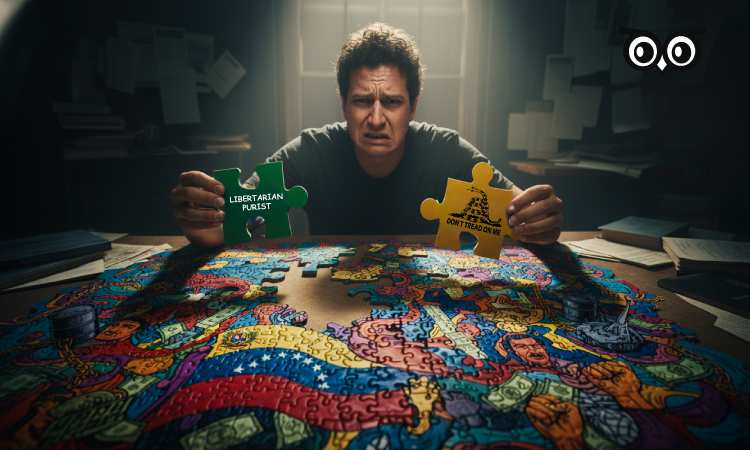
A challenge facing self-proclaimed libertarians is that they often have absolutist policy prescriptions, regardless of the evidence. In such instances, they put the cart before the horse; they elevate ideology and then find, or fabricate, evidence to fit.
Confirmation bias is common among humans, but it arises especially among libertarians with foreign policy. I wrote about this a decade ago, in response to Jacob Hornberger of the Future of Freedom Foundation. This month, a similar incident occurred on one of my favorite podcasts: The Bob Murphy Show: “Ep. 462 The Full Story behind the Venezuelan Motorboats.”
I admire Robert Murphy and listen to most of his shows. If you appreciate robust economics applied to popular topics, check him out. You can hear my own appearance from earlier this year: “Ep. 380 Fergus Hodgson Gives Libertarians the Latin America Red Pill.”
In Episode 462, the guest referred to Marina Machado and Embado González—their names are María Corina Machado and Edmundo González—and revealed his lack of familiarity with Venezuela. Machado is the most prominent Venezuelan opposition politician and the recent recipient of the Nobel Peace Prize. Kyle Anzalone of Antiwar.com and the Libertarian Institute, in eagerness to promote nonintervention, also shared half-truths and outright falsities. As icing on the cake, he called Tren de Aragua “Trans day Aruga.”
The tragedy is that the episode’s premise was correct: US strikes on purported drug boats are wrongheaded. As noted by George D. O’Neill Jr. in the American Conservative, “The Trump administration has completely eschewed the legal requirements for due process or normal interdiction procedures.… Americans have tragically grown accustomed to our government assassinating people because they are merely suspected terrorists.”
Nonintervention has its merits. Chiefly, US adherents see problems abroad as (1) not worthy of taxpayer dollars, (2) likely to get worse with entanglement, and (3) beyond US moral authority. Confiscations of assets by US officials—at least US$700 million thus far from the Soles Cartel—also point to ulterior motives.
There is a temptation, however, to both wrongly criticize the United States and downplay the problems with or legitimize autocratic regimes. The mocking of libertarians for supporting Russian President Vladimir Putin is one such instance. For transparency, I have defended some elements of Anastasio Somoza Debayle’s 1960s–1970s less-than-democratic tenure in Nicaragua. The best sources on this are Nicaragua Betrayed (1980) by Jack Cox and Somoza and “Dictatorships and Double Standards” (1979) by Jeane Kirkpatrick.

Aside from not knowing the main characters’ names, what did Anzalone get wrong? Let me offer a few cases, all from the first half hour.
- Marco Rubio has advocated regime change in Colombia.
- “Venezuela is not a major hub for drug trafficking.”
- The Miami Herald is “definitely” right wing.
- Venezuelans are not coming to the United States in high numbers.
- With “attempt after attempt after attempt,” the CIA has sought to overthrow Chavistas.
- It is “very possible” that Nicolás Maduro won his latest election outright.
- There are no direct ties between the Venezuelan government and drug cartels.
Some of his mistaken assertions are straw-man fallacies and matters of judgment, degree, or prediction: Venezuelan poverty stems from US sanctions; regime change would exacerbate emigration (20 percent have already left); Machado is “acting as a tool of Marco Rubio and the Donald Trump administration.… calling for the destruction of her home country.”
These assertions insult the intelligence of anyone who has a decent understanding of Venezuela. Poorly informed libertarians and progressives eat this up, unfortunately, since they have no frame of reference. Anzalone also promotes the leftist line that Machado “sees a lot of dollar signs” and is motivated by future “kickbacks.” There are easier ways to make money in Venezuela than to oppose the socialist dictatorship.
My recommendation is for Murphy to invite a Venezuelan, either an exile or someone still stuck there, with a comprehensive understanding of the situation. A few worthy candidates would be Orlando Avendaño, Luis Henrique Ball, Giannina Raffo, or Erik Suárez. Then the facts will be clear, and Americans can then make up their minds whether the restoration of democracy is a worthwhile mission from the US perspective.

