
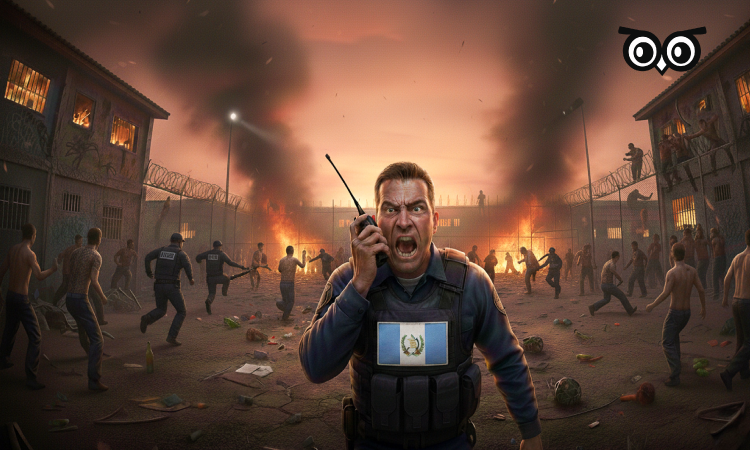
Criminal gangs labelled as terrorists, such as Barrio 18 and Mara Salvatrucha (MS-13), run the prison system in Guatemala. This has clear implications for US national security.
Recent prison breaks and takeovers and the execution of police officers expose the inability of the Guatemalan state to impose law and order. This comes after decades of subordinating the first imperative of government—establishing law and order using legitimate force—to a human-rights agenda. It prioritizes the rights of lawbreakers over those of innocent citizens and the sworn duties of duly elected and appointed officials.
The Trump Corollary announced in the National Security Strategy (NSS) makes homeland security a regional priority, redefining mass migration and drug cartels as direct security threats to the US homeland. The NSS justifies US military action within the hemisphere to address these threats. Under the NSS, the United States will work with regional champions—”like-minded” partners such as Argentina under Javier Milei and Chile under José Kast—to enforce US priorities.
The Donald Trump administration would do well to prioritize its strategic relationship with Guatemala as well. Guatemala, the largest country in terms of GDP and population in the Central American Isthmus, has a 540-mile border with Mexico. That makes drug and migration routes easier to control than at the US-Mexico border, which is about 300 miles longer.
On January 22, Guatemalan President Bernardo Arévalo met to discuss important mutual interests with a high-level US security delegation of the Department of War. The delegation was led by Senior Advisor to the Secretary of War Patrick Weaver and Acting Assistant Secretary of War for Homeland Defense and the Americas Joseph Humire.
Unfortunately, recent news out of Guatemala calls into question the country’s qualifications as a regional partner, much less a champion, to further US security interests. The visiting high-level officials from the US Congress and the Department of War could well take into account the news regarding insecurity in the Guatemalan prison system.
That would be no surprise. In Guatemala, the inmates run the prisons. On January 17, inmates affiliated with Barrio 18 seized control of three prisons, holding 46 guards and staff hostage to demand better conditions and transfers for their leaders. Notably, these takeovers occurred the day after Senator Mike Lee (R-UT) posted on X about his presence in Guatemala as part of a 14-member congressional delegation meeting with high-level business leaders.
Security forces regained control of the prisons on January 18, but gangs controlled by inmates retaliated by assassinating 10 police officers (to date) in separate coordinated attacks. In response, Arévalo declared a 30-day nationwide “estado de sitio” (state of siege), akin to martial law, and deployed the military to combat the terrorist gangs.

This incident follows a series of challenges for the Guatemalan government in controlling powerful criminal organizations that run the prison system. In August 2025, Guatemala experienced significant unrest in its prison system when members of the Barrio 18 and MS-13 gangs orchestrated riots in a juvenile detention center, taking hostages in retaliation for the transfer of gang leaders to maximum-security facilities. One should not be fooled by the term “juvenile,” as the most powerful gangs depend on violent youth for their operations.
The following month, the US Department of State (DOS) designated Barrio 18 a foreign terrorist organization. Guatemala followed suit in October, passing an antigang law that officially labeled Barrio 18 and its rival MS-13 as terrorist groups, increasing penalties for members and mandating a new maximum-security prison.
Tensions escalated further in October 2025 when many high-ranking Barrio 18 leaders escaped from Fraijanes II prison, exposing deep corruption and security lapses in the Guatemalan prison system. Local media have reported that the escapees were receiving special treatment in prison. The security lapses were impossible to deny. Many escapees had face tattoos, and one was even missing a leg.
After some delay, Arévalo eventually accepted the resignation of Interior Minister Francisco Jiménez, along with two of his deputies, amid significant political pressure. Jiménez subsequently fled the country. One escapee who was recaptured has testified that Jiménez and the ex-director of the prison had prior knowledge of the escape plan.
This sequence of events highlights Guatemala’s struggle with powerful terrorist street gangs—see here, here and here—rooted in corruption and inadequate prison infrastructure.
The worst part is that the United States has been directly involved in the structuring and reform of the Guatemalan prison system for many years—see here, here, and here. On the matter of Guatemalan prisons, the work of the US Embassy in Guatemala, and of the Bureau of International Narcotics and Law Enforcement Affairs (INL), has been a marked failure over the years.
There is one factor in common across administrations: the performance of Todd Robinson, former US ambassador to Guatemala. He left that post to become chargé d’affaires in Venezuela (in lieu of a formal ambassador) and later the assistant secretary for INL.
At INL, Robinson was responsible for overseeing international narcotics enforcement and law enforcement efforts in Latin America. The fact that Guatemalan prisons remained under the control of terrorist gangs under his watch speaks volumes about the errors of US diplomats in the region. Those implementing the new NSS of the United States need to correct these problems.

