
By Guillermo Valdés Castellanos
Mexican President Claudia Sheinbaum began her term under unbeatable conditions. She had striking legitimacy and political capital after winning the election with 60 percent of the vote. Sheinbaum enjoyed the full support of former President Andrés Manuel López Obrador (AMLO) and his enormous popularity.
She held an unprecedented level of presidential power in the country’s history, enabled by:
- subordinated legislative and judicial branches;
- qualified majorities in both chambers to amend the Constitution at will;
- the dismantling of key political counterweights;
- an irrelevant opposition.
Sheibaum also had a reputation as a serious politician with strong academic credentials.
She had everything to build an extraordinary second stage of AMLO’s political project: the Fourth Transformation (4T). Unfortunately, there was no design for such a project, and even if there had been—after 15 months in office—her administration lacks a clear direction.
A continuous succession of political crises and violent events since May 2025 have created the perception of a government under siege. These developments include corruption scandals, alleged links between Morena and organized crime, natural disasters, pressure and threats from the United States, economic downturn, and waves of protest mobilization. As a result, the Sheinbaum administration appears largely reactive, lacking a clear agenda or an overarching governing strategy.
Sheinbaum is trapped in a political minefield, shaped by domestic failures and international pressures. Domestically, her administration has inherited the disaster created by AMLO. Sheinbaum’s predecessor not only failed to build the 4T’s first stage but dedicated himself to destroying even the foundations he found. Internationally, Mexico confronts US President Donald Trump’s second term and its aggressive anti-Mexican policy.
The Sheinbaum administration has devolved into a poorly prepared and ill-equipped firefighting operation, scrambling to contain crises erupting across the country. A review of events linked to her predecessor’s legacy confirms this.

What Sheinbaum Inherited from AMLO
There is no need to extensively focus on the facts and figures, since most are well known. A brief and structured overview is enough to grasp the magnitude of the inherited disaster.
Economy
- Stagnant Growth
GDP grew at an average annual rate of 0.4 percent during the AMLO administration. This translated into missed opportunities, abandoned/postponed projects, a widening infrastructure gap, jobs-creation scarcity, and more. Sheinbaum attempted to address these issues through Plan Mexico, which is infeasible for several reasons, including the following element.
- Business Elites’ Distrust
Despite persistent efforts to court leading business figures, the broader set of AMLO’s economic decisions—including the cancellation of the Texcoco airport, fiscal intimidation, and energy nationalization—continously discouraged domestic private investment.
- Rising Deficit, Public Debt
In 2024, the fiscal deficit reached 6 percent of GDP, while public debt increased from 10 to 17 trillion pesos. This was due to exorbitant public spending with little productive return:
- an underused airport and train that cost three times their original budgets;
- massive spending on cash transfer programs with limited social returns;
- an unnecessary and extremely expensive refinery;
- rampant corruption.
- Rigid Public Spending
As debt servicing costs have reached 4 percent of GDP, the government has been forced to cut spending on education, medical care, environmental protection, agriculture, research and development, and public investment. For every peso allocated to education, three pesos are spent on interest payments; for every peso allocated to the Health Ministry, fourteen pesos go to servicing the debt. Debt servicing costs three times the combined budgets of Defense and the Navy, 13 times the budget of the Security Ministry, and 15 times total public investment.
- Deficient Energy Policy and Pemex
A state-centric vision of energy autonomy—excluding private-sector participation and aimed at reducing/eliminating gasoline imports—has pushed state-oil company Pemex into a dead end. This has affected electricity supply, leading to widespread blackouts in the southeast.
Fundamental flaws in Pemex’s business model make short-term financial recovery unlikely. The nearly two trillion pesos (US$110 billion) transferred to the company by the Finance Ministry during the previous administration failed to resolve its productive or financial crisis.
- Weakened Agricultural Policy
To complete this picture of mounting challenges, AMLO’s decision to curb agricultural support policies and dismantle rural financial institutions has created new pressures for Sheinbaum. Corn producers, facing a sharp drop in prices, are demanding subsidies. They have mobilized across multiple regions of the country, blocking highways and major roads and causing significant damage to regional economies.
Security
The security challenges left by the AMLO administration are perhaps even more troubling. While much has been written about the severe consequences of the “hugs, not bullets” strategy, it is important not to lose sight of them.
The repercussions include hundreds of thousands of lives lost through killings and disappearances, family tragedies, and lost livelihoods. This has translated into a climate of permanent fear and the defenselessness of citizens struggling with violence exercised by psychopaths and sociopaths, shielded by the political and economic greed of a new arrogant and despotic ruling class.
The measurable legacy is staggering. According to the Statistics and Geography National Institute (INEGI), over 208,000 Mexicans have been reportedly killed. Thousands of additional murders hide in the category used by state prosecutors under “other crimes against life.” Further, more than 55,000 people are missing.
What is harder to quantify are qualitative consequences, such as the following:
- The boundaries between illicit networks and the society, the economy, and politics have rapidly blurred. This has empowered economically and politically a complex and widespread criminal ecosystem.
- Criminal groups have not only expanded within conventional illicit markets—drugs, arms, migrants, and human trafficking—but have also driven two of them—fuel theft and extortion—to unprecedented levels. In addition, they have moved into legal markets—avocado production, construction, mining, fishing, and others—through their own companies, de facto expropriations, or control over regional markets.
- In the political sphere, there is growing evidence that—beyond controlling mayors, police forces, and prosecutors—criminal organizations have allied with state-level ruling parties. These arrangements grant territorial control in exchange for electoral support. In other words, they gain leeway for criminal operations and impunity in exchange for political dominance. To complete the cycle, the federal government guarantees impunity for governors. Sinaloa is the emblematic case but not the only one subject to these arrangements.
- In many regions of the country, it is no longer clear where the lines lie between criminal organizations and political, economic, and social structures. De facto systems of criminal governance have taken hold, normalizing violence and insecurity. Organized crime now performs core state functions: the use of force, tax collection through extortion, dispute resolution, and the imposition of a new order based on arbitrary power. The murder of politician Carlos Manzo starkly confirmed this reality. It openly undermined Security Minister Omar García Harfuch’s strategy and called into question official claims of declining homicide rates.
Politics
AMLO’s main political legacy was the consolidation of a new regime. He concentrated power in the executive branch without checks and balances, enabling the 4T perpetuation. This has required Sheinbaum not only to complete the reforms already underway, but also to share control of the country with her predecessor and deal with the consequences.
- Judicial Reform
During the first half of 2025, much of the political agenda focused on organizing and carrying out the judicial election. The process was full of errors, improvisation, irregularities, and widespread violations of electoral law—including the well-known “cheat sheets.”
The result was, on the one hand, an election with minimal participation and little legitimacy. On the other hand, the new Supreme Court and a significant share of judges and magistrates lack the legal, political, and technical capacities required to administer justice. Hundreds of thousands of citizens and firms involved in ongoing legal proceedings are about to feel the consequences of an undermined judicial system.
- Politicization of Prosecution, Justice
The appointment of Alejandro Gertz Manero as head of the Attorney General’s Office (FGR) marked the beginning of lawfare: the creation of new offenses subject to mandatory pretrial detention followed, alongside politically motivated investigations carried out by the Financial Intelligence Unit (UIF) against opponents, journalists, and critics. Despite the evidence of internal corruption or links to organized crime, the FGR responded with silence and inaction. The message to insiders was clear: there is a pact of impunity, and anything goes.
- Corruption, Impunity
That message was clearly understood. By mid-2025, the 15-billion-peso embezzlement at the state-run food security agency Segalmex was overshadowed by revelations of a far larger scheme involving Pemex and the Finance Ministry. The latter totaled 600 billion pesos, forty times the Segalmex case.
The latter involved a network of high-level officials across multiple federal agencies—Defense, Navy, National Guard, Finance, Customs, Energy, Pemex, and consumer protection authorities along with state governments and ruling-party Morena leaders, in collaboration with Mexican and US companies. Nothing stopped them, not even the ethical guidelines promoted by Sheinbaum.
An excessive appetite for public resources, luxury lifestyles, and ostentatious displays of wealth proliferated. Some of the most visible cases include:
- Adán Augusto and his network of business interests;
- Gerardo Fernández Noroña’s house in Tepoztlán;
- the luxury trips to Japan of AMLO’s son, known as Andy;
- Alex Tonatiuh Márquez’s Rolex watches;
- the lifestyle of Congressman Sergio Gutiérrez and his wife.
The complicity imposed by AMLO—enforced and managed by Gertz—became a legacy with high political costs. The narratives “we are not the same” and “corruption is over” rapidly weakened under his administration. To cap off the year, the Interoceanic Train project became yet another byproduct of corruption in AMLO’s megaprojects.
- Plan C
Consolidating an authoritarian, populist regime required extensive legislative work. Congress militarized public security and laid the groundwork for a surveillance state and greater media control through administrative, intelligence, and telecommunications laws. Congress dismantled autonomous institutions and intimidated both citizens and the business sector through changes to the legal protection system. Congress also revived state monopolies in the energy sector.
Through electoral reform, Morena secured supermajorities in Congress while reducing the opposition to permanent marginality. Legislating hastily—through poorly drafted laws passed without prior reading or analysis of their consequences, in violation of legislative procedures and without dialogue—became the norm in congressional sessions.
Social Policy
A stagnant economy, fragile public finances, a struggling agricultural sector, unchecked insecurity, expanding criminal governance, and a thriving corruption–impunity nexus are not all. The institutional foundation of social policy, reduced largely to cash transfer programs particularly in medical care and education, now requires urgent attention.
- Medical Care
Few people anticipated that, seven years after dismantling the pharmaceutical procurement system and Seguro Popular—a public health system for those without social security—the consequences would remain unresolved. Issues include:
- the return of previously eradicated infectious diseases;
- 30 million Mexicans without access to services;
- deteriorating conditions in public hospitals;
- rising out-of-pocket health expenditures;
- tens of thousands of preventable deaths;
- dwindling vaccination rates.
Overcoming the budget cuts, incompetence, improvisation, corruption, and irresponsibility left by AMLO—especially during COVID-19—will require significant time, effort, and resources.
- Education.
In 2022, the AMLO administration implemented an education model known as the “New Mexican School.” Among other things, this pushed science, including mathematics, out of the classroom and restored the political influence of the teachers union (CNTE).
CNTE has now returned to demand control over teachers’ payrolls and the reversal of the 2007 pension reform, forcing Sheinbaum to manage an increasingly difficult ally. Meanwhile, nothing has been done to address:
- the decline in learning outcomes among children and young people;
- the fact that more than one million students never returned to school after COVID-19—largely because there is no organized constituency pushing back.
Implications, Projections for 2026
This nonexhaustive account of what AMLO left behind—excluding foreign policy, environment, science and technology, culture, and basic infrastructure—was built on objective facts. Those facts, undeniable even for defenders of the 4T, include:
- economic and security statistics;
- social-media evidence of the lavish lifestyles of Morena officials;
- direct contracts awarded to companies owned by relatives and associates;
- FGR investigations into fuel-tax evasion, empty pharmacies, and reported measles cases.
This account reveals three core implications and their consequences for governance.
The AMLO administration set Mexico on a highly dangerous path. He not only failed to resolve the main problems. He worsened them and dismantled many of the state’s capacities to address them. He destroyed institutions, canceled policies and programs, and replaced them with misguided policies rooted in ideology and personal whims. He eroded qualified human capital in government functions and misused, abused, and wasted public finances.
Sheinbaum’s government is not about building any second stage, but rather managing aggravated problems with diminished capacities, limited resources, and weakened institutions. As a result, the first pillar of governance—the government’s effectiveness in solving problems—remains at low levels, with no signs of improvement.
This explains the growing discontent driven by economic, social, and security concerns among key sectors and social groups in recent months. Among others, critics include agricultural producers, transport workers, teachers, judicial and healthcare workers, Generation Z, and families of the disappeared. This phenomenon was not seen during AMLO’s term.
While Sheinbaum’s popularity remains high, the approval of the government’s performance on major issues—particularly regarding organized crime and corruption—has dropped sharply. Protests, however, remain fragmented. There is no political or social leadership capable of articulating them into more effective actions to shift the government’s course or into an organized electoral force capable of challenging Morena in 2027.
In this sense, a second pillar of governance—social support—shows two faces: a positive presidential approval and an eroding support for government performance.
As obvious as it may be, the third implication is critical—the concentration of legal authority and instruments of power in the executive. The subordination of the judiciary through popular election, along with weakened business-sector, media, and civil-society organizations—given the discretionary use of prosecution, surveillance mechanisms, and the erosion of legal protections—represents a hard blow for democratic institutions.
Unlike during AMLO’s term when this process began, the constitutional and legal reforms enacted during Sheinbaum’s first 15 months allow us to speak of legalized authoritarianism. Many policies, laws, and decisions that were previously illegal or unconstitutional under AMLO—some overturned by the Supreme Court or through injunctions—are now legal. This results in power without checks and balances.
The deterioration of democratic governance is both evident and significant. It reflects an exercise of power that has abandoned democratic principles. Moreover, power has been exercised with extreme discretion, enabled by the absence of limits.
The government neither listens to reason nor engages in dialogue beyond its inner circle. The closed-off approach adopted by both AMLO and Sheinbaum has led not only to serious mistakes but also to an inability to correct them. Without institutional constraints or external criticism, the damage caused by misguided public policies becomes effectively limitless.
The mishandling of the pandemic and the refusal to adjust course led to 300,000 preventable deaths; the “hugs, not bullets” policy led to 200,000. Carlos Manzo, for instance, repeatedly requested protection and was denied.
AMLO knew that judicial reform would deepen business distrust, contributing to economic stagnation and the loss of hundreds of thousands of jobs. Financing social programs without fiscal reform or economic growth forced the government into debt, the servicing of which now suffocates public finances. Sheinbaum, however, continues borrowing.
The authoritarian governance AMLO and Sheinbaum have built has translated into a deeply arrogant, ineffective government with soaring damage to society. Under these conditions, the outlook for 2026 is not very encouraging. Overcoming AMLO’s legacy necessarily requires Sheinbaum to take ideological and political distance from her predecessor and his circle, as she has partially done in the area of security.
However, the likelihood of this occurring in other areas—such as electoral and judicial reform, energy policy, the complicity of Morena members with organized crime, and the militarization of the National Guard—is minimal for two reasons.
- Sheinbaum believes that many of these policies are either correct (for example, energy nationalization) or necessary (such as judicial reform).
- Morena’s unity is a necessary condition for winning elections, which is the primary objective of the 4T, so it cannot be put at risk. A political division would happen, for instance, if corruption were investigated or if García Harfuch’s strategy did not stop short of politicians and officials linked to organized crime.
However, reality and external factors—particularly the Trump presidency—will force her to act on specific issues and in a gradual manner. Thus, 2026 may be a year of balancing acts with domestic and international challenges demanding an effective government capable of addressing the country’s major inherited problems. In the meantime, the government seeks to reconcile its authoritarian and populist model, based on Morena’s unity and a dual power arrangement with AMLO. Let us examine the most relevant issues.
Economy
All indicators suggest the economy will experience minimal growth, between 1 and 1.5 percent, with relatively high inflation of around 4 percent. This is insufficient to meet the needs of the population but enough for the government’s stability.
The population’s economic conditions are unlikely to be significantly affected in the run-up to the 2027 elections. As long as there is no economic crisis, there will be no political cost. The rhetoric of the morning press conferences, combined with cash transfers, helps sustain social support. AMLO showed it is possible to remain popular even with a stagnant economy.
Although Sheinbaum may seek higher growth in discourse, as reflected in her Plan Mexico, in practice the priority is to remain in power by winning elections. Otherwise, she would prioritize eliminating the political factors that have hindered private investment and generated significant distrust and uncertainty: judicial reform, fiscal pressure, rushed legislation, energy statism, electoral reform, and so on.
To achieve minimal growth and a degree of fiscal discipline for preventing an economic crisis and preserving funding for social policy, Sheinbaum must address two delicate processes.
- The renegotiation of the USMCA starting in July: This involves maintaining the agreement that sustains the export sector, which is expected to account for around 1 percent of growth this year. Mexico cannot afford to put it at risk. This will not be easy given the aggressiveness shown by Trump, particularly following the events in Caracas. The willingness of the White House to use any negotiation tool—from introducing demands of all kinds to military pressure—now adds to the historic asymmetry of power between Mexico and the United States. It is likely that, despite resistance and attempts to leverage comparative advantages and support from US companies, Mexico will have no choice but to accept the terms imposed. In doing so, the agreement will remain in place, but its strength and duration remain uncertain.
- Controlling Pemex’s losses: Over the past seven years, the federal government has transferred more than two trillion pesos to the company through various mechanisms, from direct budget allocations to tax relief. Despite this, Pemex remains heavily indebted and continues to generate massive losses. In short, it has become a black hole for public finances. Although a new business plan has been presented to rescue the company, there is no certainty it will succeed, and it could become a destabilizing factor for public finances.
Beyond these two key pressure points, most government actions will remain rhetorical. Officials will continue courting business leaders, who will express support without committing to timelines. In the morning press conferences, they will highlight progress in the USMCA review and emphasize the strength of the relationship with Trump. They will point to exchange-rate stability, the limited number of jobs created, and foreign-investment figures.
Security
This is the most recognized and publicly promoted area of Sheinbaum’s administration, to the point that it has begun to restore a relationship of trust with the United States. However, after the assassination of Uruapan’s mayor, Carlos Manzo, the security strategy’s constraints became evident. Doubtful achievements like the reduction in homicides have proved insufficient. Moreover, criticism has intensified due to the halting of investigations in two key cases involving links between members of her party and organized crime: fuel-tax evasion and La Barredora. This, in turn, generated strong disapproval of Sheinbaum for consolidating the pact of impunity for Morena members inherited from AMLO’s administration.
There is little indication that 2026 will bring changes from within the government. García Harfuch will continue doing what he does best: carrying out specific successful operations based on intelligence work. These include the arrest of leaders of violent cells, the dismantling of laboratories, and targeted actions against specific crimes like extortion and highway robbery. However, all of this will have limited impact due to the structural constraints:
- the inability to sustain operations because of ineffective local police forces;
- the limitations and inexperience of the National Guard;
- the backlog within prosecutors’ offices.
The political returns of this strategy will be diminishing.
The government will also continue to highlight reductions in homicide rates, even as doubts persist about their true magnitude. Authorities have not clarified the evident statistical manipulation in the classification of homicides and “other crimes against life.” Moreover, several regions of the country will remain areas of high violence due to ongoing shifts in criminal structures and markets.
The central question in security policy is how the government will respond to growing demands to end the impunity of politicians who protect and profit from their links to organized crime. It is already clear that domestic social pressure will not move Sheinbaum. However, the problem is the White House appears increasingly willing to intervene, even through military means. Recent actions linked to narcotrafficking have sent a clear signal of what the United States may be willing to do to advance Trump’s political objectives.
The president’s room for maneuver has narrowed considerably. Just weeks ago, the worst-case scenario for the government was the possibility that the United States might publish a list of high-level politicians for extradition. Now, the president’s nightmare may be waking up at midnight to reports of US helicopters landing at a government palace or a ranch near Palenque (where AMLO now resides).
The rational course would be for Sheinbaum to take the initiative for two reasons:
- to prevent military intervention and reduce vulnerability in USMCA negotiations;
- to increase the effectiveness and credibility of the strategy to dismantle criminal organizations, since failing to prosecute the politicians who protect them only strengthens them.
The people of Sinaloa, Tabasco, Michoacán, and many other states are paying the price. So far, however, all indications suggest that, from her perspective, the political cost—in terms of Morena’s unity and the support of its hardline factions, as well as AMLO himself—would be greater. Once again, the government is performing a costly balancing act between avoiding conflict with her predecessor and the need to govern.
Politics
The government’s political action in 2026 is shaped by the 4T’s major success in 2025: the consolidation and legalization of an authoritarian model of governance, which now lacks only one key piece—the electoral reform. If Sheinbaum has already realized that managing the disaster she inherited without sufficient effectiveness has generated growing social discontent, then the risk of electoral losses in 2027 also increases (translating to the loss of a supermajority in the Chamber of Deputies and governorships). The corollary is clear: electoral reform must ensure that this does not happen.
Therefore, there will be no concessions to the opposition—less funding, fewer proportional representation seats, easier rules to secure supermajorities, and subordinated electoral authorities. There will be an intense and contentious debate, with the possibility that the Workers Party and the Mexican Green Ecologist Party may break from the ruling coalition and that authoritarian regression will be denounced internationally. However, the 4T will ultimately prevail.
The country will become more polarized, and the hardening of the presidency—fully displayed during the November 15 march led by Generation Z—will define the political tone of the year. Disqualification and attacks against the opposition will be more easily justified in the name of national unity in the face of threats from Trump. Accusations of treason will proliferate against those who dare to dissent or demand an end to corruption and impunity among those who have aligned with and protected criminal organizations. All of this will serve to maintain Morena’s unity, prolong the approval of the figure in Palenque, and consolidate power.
Finally, in the face of a new, serious global disorder and the emerging profound geopolitical realignments following the indefensible US intervention in Venezuela, two elements of AMLO’s legacy acquire enormous relevance. The current government has done nothing to correct them, and failure to do so will result in significant costs for Mexico.
- The absence of a serious foreign policy: Defending dictatorships and engaging with adversaries of the United States while simultaneously seeking preferential trade treatment are incompatible positions. Reducing the relationship with the United States to phone calls with Trump and invoking national sovereignty in daily press conferences reflects a very limited understanding of diplomacy. Leading a presidency without traveling abroad or participating in multilateral forums to build strategic alliances, thereby isolating the country, is equally misguided. Relying on the Estrada Doctrine as a one-size-fits-all response to global events in order to position the country in a collapsing international order is clearly insufficient. How can Mexico defend its interests in this new context of a breakdown of international law and violent struggles to impose spheres of influence?
- A vanished national security policy: CISEN, now the CNI—responsible for coordinating the national risk agenda to protect national interests—was dismantled and reduced to a minor public security agency. AMLO’s lack of understanding in this area was not surprising. However, the current government’s insistence that the CNI focus solely on public security investigations to support prosecutors, as Sheinbaum stated last December, is a serious mistake. All states maintain national security policies to define strategies for risk prevention and management, to determine how to prevent threats or minimize their impact.
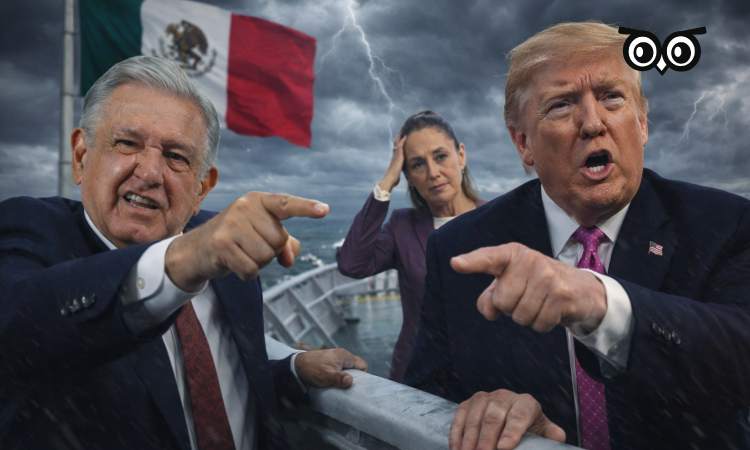
Without a serious foreign policy and without a national security strategy, Mexico will be a ship adrift—without a rudder or engine—in a storm that has already begun.
This article first appeared in Spanish in Letras Libres. Guillermo Valdés Castellanos is a national security specialist. He served as director of the Center for Research and National Security (CISEN) and is a partner at the Associated Economists Group (GEA).

