
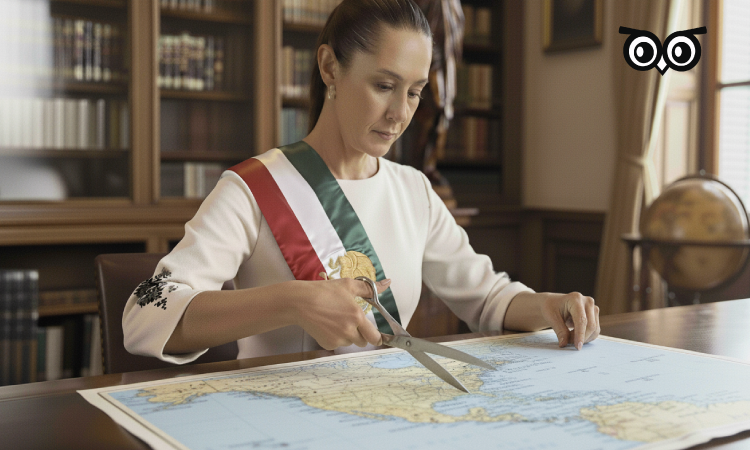
On October 5, Mexican President Claudia Sheinbaum delivered her first annual report, celebrating what she called “economic achievements.” Behind the triumphant tone, however, lies a troubling picture of stagnation and squandered opportunity.
When Mexico faced a nearshoring boom that could have transformed its economy, Sheinbaum’s administration doubled down on paternalism and centralized control. Instead of empowering private enterprise to pounce on global investment flows, Mexico chose to expand the state’s grip on industry, resources, and credit. The US$12 billion bailout this year of Petróleos Mexicanos (Pemex) is one example of many that favor patronage over private-sector development.
Mariana Campos, director of free-market think tank México Evalúa, puts it succinctly: “The 2026 Economic Package is not a plan to catapult Mexico into the 2030s. It is a roadmap for managing scarcity without altering the status quo.”

What the Numbers Say
Sheinbaum proudly announced the economy grew 1.2 percent in 2024, an achievement she claimed defied pessimistic forecasts. However, that figure marks the Mexican economy’s worst performance since the 2020 pandemic-year contraction.
Even more revealing is the hollow nature of her so-called social justice. Sheinbaum boasted that income inequality between the richest and poorest population percentiles had narrowed from 27 to 14 times. Nevertheless, GDP per capita grew only 0.6 percent, down from 2.4 percent the year before. According to World Bank data, Mexico’s per capita output barely rose from $10,253 to $10,313 (in constant 2015 US$ prices).
The Price of Paternalism
Sheinbaum’s selective storytelling hides the cost of her redistributive model: slow growth, eroding productivity, and falling competitiveness. Moreover, a flagship policy of the Sheinbaum administration has been rescuing the state-owned Pemex, the world’s most indebted oil company.
For doing so, the Ministry of Finance has allocated taxpayer money to absorb much of Pemex’s debt and financing costs. Mexico is turning private-sector capital that could fund innovation and infrastructure into subsidies for inefficiency.
Mexico’s 2026 budget assumes production of 1.79 million barrels per day, which has not been reached since 2023. If the numbers fall short, rating agencies such as Fitch and Moody’s have warned they may downgrade Mexico’s sovereign credit in 2026.
Although Mexico still holds a Baa2 rating with Moody’s, the country already pays the highest borrowing costs among investment-grade economies. Losing that investment-grade status across all three major ratings agencies—as Mexico is on the verge of doing—would make credit scarcer and even more expensive, further weakening the investment climate.
Mexico’s relatively low tax burden compared to other OECD nations—a long-standing advantage—is set to come under pressure. This will corner Sheinbaum’s or future administrations into raising taxes and undermining the legal certainty investors seek.
Unbloomed Nearshoring
Mexico has everything for nearshoring: (1) proximity to the United States, (3) trade integration through the USMCA, (3) competitive labor costs, and (4) untapped industrial capacity. In theory, Mexico should be the natural hub for companies relocating production from Asia to the Americas.
However, by clinging to a centralization vision and prioritizing wealth redistribution, the federal government is letting the moment of opportunity slip away. Meanwhile, competitors such as Guatemala, El Salvador, and Panama are actively courting US investment with friendlier regulatory frameworks.
US President Donald Trump’s policies to boost regional manufacturing have increased the opportunity and the cost of Mexico’s hesitation. As Campos warns, “We are looking at a country that, having the chance to rebuild its essential capabilities to become a competitive partner in North America, simply refuses to board the train.”
A Way Forward
The path to recovery does not lie in doubling down on Pemex or populist spending. Mexico can start by replicating successful models at the local level. A 2025 México Evalúa study found that Querétaro offers a glimpse of what Mexico could become if it embraced cost-effective governance, legal certainty, and market openness. The state has built one of the country’s most dynamic industrial ecosystems, anchored in manufacturing, aerospace, and information technology. Its network of industrial corridors—Santiago de Querétaro, El Marqués, and San Juan del Río—connects directly to US markets and global supply chains
The Evalúa study also found that regulatory delays cost local firms over 3 million pesos ($150,000) in lost opportunity per project, mostly due to bureaucratic bottlenecks in municipal permits. Therefore, simplifying administrative processes and guaranteeing faster and more transparent approvals would boost competitiveness nationwide.
If Mexico wants to retain investment-grade creditworthiness and seize the nearshoring opportunity, it must turn the ship around: cut red tape, decentralize industrial policy, and create a regulatory environment in which private capital leads. Empowering regions to replicate Querétaro’s efficient governance, infrastructure, and public-private coordination would do more to attract global manufacturing than any state-run oil rescue plan.

