
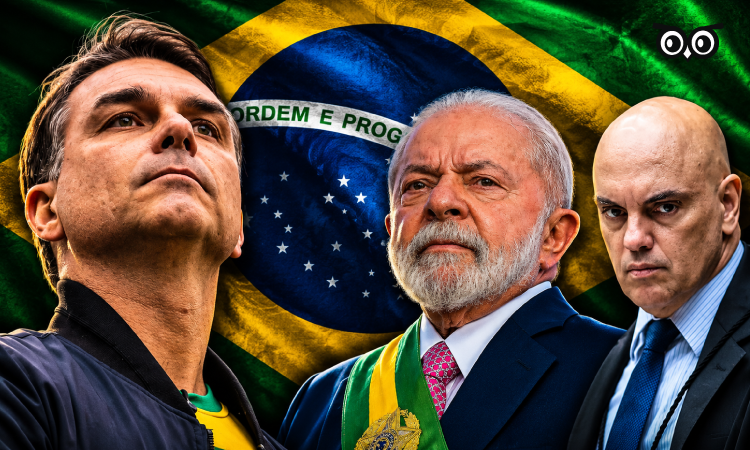
While claiming electoral foul play, Brazilian Senator Flávio Bolsonaro fled the country for the United States. This came just hours after losing the October 25 presidential runoff to Luiz Inácio Lula da Silva, although Bolsonaro comfortably won the first round of voting. The day after the runoff vote, Supreme Federal Court (STF) Justice Alexandre de Moraes ordered Bolsonaro’s passport withheld and barred him from leaving Brazil. The measure was allegedly taken as part of an investigation into money laundering in which Bolsonaro denies any wrongdoing.
Both Bolsonaro’s decision to leave Brazil and his refusal to accept defeat raise questions about his commitment to democracy. However, the underlying problem is the growing politicization of Brazil’s judiciary and the reality that institutions have become instruments of retaliation against those who challenge the established powers.
In this case, exile is effectively serving as a safeguard against potential judicial abuses. Nevertheless, by removing a figure capable of uniting the Brazilian opposition, the forces that could challenge the ruling party are weakened. What represents an individual escape from potential abuses of power has become a de facto political victory for those who control the institutions, eroding them even more.
CARTA À NAÇÃO BRASILEIRA 🇧🇷 28.10.26 https://t.co/QqOGZuF8G0
— Flávio Bolsonaro (@FlavioBolsonaro) October 28, 2026
A Runoff Marked by the Incumbent’s Advantages
Some of the policies enacted during the campaign fueled criticism over the use of public resources for electoral purposes. The government increased transfers under the Family Basket Bolsa Família program by 15 percent, introduced relief measures for entrepreneurs, and promoted a proposal for free public transportation on weekends. It also announced transfers of up to 5,000 reais (US$910) to small businesses, aimed at benefiting one million entrepreneurs starting in 2027. These combined measures are estimated to amount to 2 percent of GDP—quite the campaign budget.
Moreover, on the runoff day, STF Justice Cristiano Zanin—a former personal attorney to Lula—ordered voting to be extended until 7 p.m. following reports of public transportation disruptions. After the Superior Electoral Court (TSE) pointed out that numerous polling stations had already closed, the order was clarified to apply only to polling stations that remained open. While such events are not conclusive enough to prove fraud, Bolsonaro alleged a tilted playing field and announced he would challenge the results.

The Leading Figure in Judicial Collusion
STF Justice Moraes is one of the most powerful and controversial figures in Brazilian politics. For instance, he was the rapporteur in the criminal case against former President Jair Bolsonaro (Flávio’s father), who was sentenced in 2025 to 27 years in prison for his involvement in an alleged plot to alter the 2022 election results.
Moraes also appeared in documents disclosed from the Banco Master case, a huge Ponzi fraud scheme including money laundering from corrupt politicians and the country’s largest criminal group Primeiro Comando da Capital. In particular, the Federal Police revealed a contract worth around 131 million reais ($24 million) between Banco Master and the law firm of Viviane Barci de Moraes, the justice’s wife.
Moraes was appointed to the Supreme Court in 2017 by former center-right president Michel Temer and had previously held positions associated with that political faction. Today, the Brazilian conservative movement views him as a political adversary aligned with the ruling party. This evolution illustrates why the problem cannot be reduced merely to ideological labels. The central question is whether those exercising judicial power act impartially and are subject to effective checks and balances.
The center of the Brazil story is not Flavio Bolsonaro but rather Alexandre de Moraes, who has utterly destroyed the credibility of the Brazilian justice system and its democracy through years of escalating persecution against critics, dissidents and political opponents, all while the Brazilian left celebrated him for doing it. That’s why countries now routinely reject Brazil’s extradition requests in Moraes’ cases, and why international media has continuously warned of Brazilian authoritarianism as a result of the censorship and imprisonment regime that the Brazilian left built with Moraes as its leader. (And all of that is separate from the massive corruption scandal he’s at the middle of, where his family received $40 million from the corrupt billionaire who caused Brazil’s largest-ever banking collapse). If you don’t start your "reporting" about the Bolsonaro/US case by emphasizing that it was Moraes who ordered Bolsonaro’s passport seized and banned him from leaving the country — as an obvious prelude to arresting him even though he’s been charged with no crimes — then there’s no way to understand what happened here let alone explain to readers and viewers why Flavio Bolsonaro would never have gotten anything remotely resembling a fair trial.
— Glenn Greenwald (@ggreenwald) October 29, 2026
Elections as Cover for Censorship
After being declared the winner, Lula pledged to regulate social media, citing alleged interference in the electoral process. In 2024, Moraes had already ordered the suspension of X in Brazil following a dispute over compliance with judicial rulings, including orders to remove content and appoint a legal representative.
The platform resumed operations 39 days after meeting the court’s demands and paying fines. Although courts must be able to enforce the law, content removal orders and platform bans require clear standards, proportionality, and effective appeal mechanisms.
Not every investigation into a political leader constitutes political persecution, just as alleging a conspiracy does not make a defendant innocent. This is precisely why due process, judicial independence, and the ability to challenge arbitrary decisions are essential.
Lula’s own trajectory demonstrates the importance of these safeguards. The Supreme Court revoked his convictions on technicalities, and the UN Human Rights Committee concluded his procedural rights had been violated. While we cannot conclude his innocence regarding every allegation investigated, these outcomes do demonstrate that due process matters.
When justice becomes an instrument of political revenge, institutions cease to act as impartial referees and tilt the balance towards those in power. Governments can use them to neutralize their opponents, while the opposition and their electorate lose confidence in democratic rules and elections. The outcome is increasingly contentious transfers of power, a weakened and fragmented opposition, and fading republican checks and balances. Brazil has a dire need for independent courts, due process guarantees, and effective limits on state power.


