
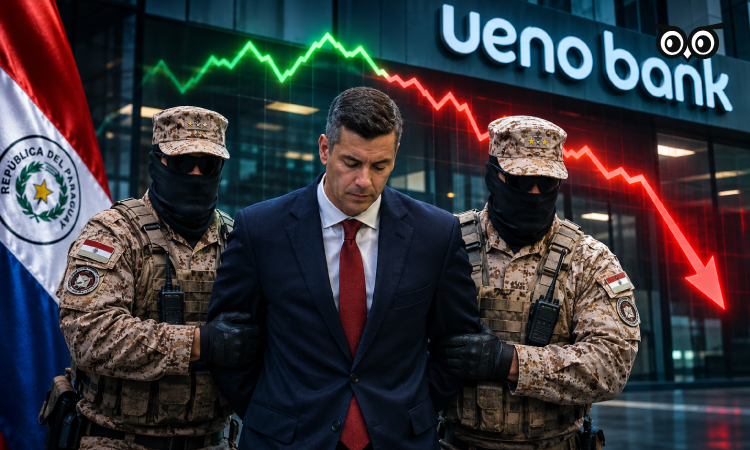
On November 3, the Central Bank of Paraguay began the dissolution of Ueno Bank. It was one of the country’s most popular financial institutions, serving almost 50 percent of the population. Branded as a case of entrepreneurial success and financial innovation, Ueno ended up unveiling a crony network of political connections and financial irregularities.
The dissolution measure was taken once Ueno’s solvency ratio fell below half the legal minimum. Prosecutors charged 27 people over alleged irregularities involving loans and overdrafts extended to companies tied to bank owners.
The investigation from the Public Prosecutor’s Office revealed ties between Ueno and then President Santiago Peña, who resigned as soon as the scandal became public. Congress rejected his resignation in order to impeach him, since Paraguayan law grants former presidents parliamentary procedural immunity, which means immunity from criminal prosecution. Sitting as a court, the Senate voted unanimously, including the entire ruling-party caucus, to remove him. Peña is now in military custody awaiting a criminal trial that could bring up to 15 years in prison.
The investigation also revealed ties between Ueno and President Santiago Pena, who resigned as soon as the scandal became public. Congress rejected his resignation to impeach him, Paraguayan law grants former presidents procedural immunity. Then, sitting as a court, the Senate voted unanimously, including the entire ruling-party caucus, to remove him. Peña is now in military custody awaiting a criminal trial that could bring up to 15 years in prison.
Ueno’s dissolution has shaken the Colorado Party, which has governed Paraguay for 74 of the past 79 years. After Peña’s ouster, Vice President Pedro Alliana assumed the presidency. Meanwhile, former president and party strongman Horacio Cartes regained prominence by backing the impeachment and mobilizing his faction against Peña. Paraguayan political analyst Estela Ruiz Díaz described the episode as a “controlled implosion” within the Colorado Party to hold on to power.
#ParaguayWatch🇵🇾: The Ueno Bank scandal becomes MORE BIZARRE. Investigators have uncovered a hidden vault in former Pres. Peña’s mansion, complete with an Israeli security system. SKELETONS KEEP COMING OUT OF PEÑA’S CLOSET. https://t.co/wazw5dVkdj
— Steve Hanke (@steve_hanke) November 9, 2026
Ueno’s Rise and Fall

Licensed as a bank in 2023, Ueno expanded rapidly thanks to its digital-banking model, which gave millions of previously unbanked Paraguayans their first bank account and credit card. Ueno was even touted as a potential Paraguayan unicorn. Its clients also included public institutions. As of June 2026, public entities such as the Social Security Institute (IPS), held around US$850 million in deposits at the bank—most of which remains inaccessible.
Internal reports from the central bank’s own regulatory arm, leaked to the press in October 2026, warned of an excessive concentration of loans in certain companies. Subsequent investigations cast suspicion over transactions with firms tied to the ownership group and whether the bank’s actual financial position matched its statements.
The scandal turned political when it came to light that Peña held a stake in the holding company until March 2025, more than a year after his inauguration. Moreover, after taking office, he appointed Carlos Carvallo, Ueno’s former president, as the head of the Central Bank. Carvallo resigned in the wake of the scandal and was charged by prosecutors. Likewise, Peña has been formally charged with breach of trust, self-serving mismanagement, and criminal association.
There appear to be many individual crimes for the courts to identify and verify. However, the key issue for macro analysis is the evident conflict of interest among political authorities, financial supervisors, and those running the bank.
On November 11, the Central Bank reported that all customers eligible for the state guarantee had received at least part of their savings. Nevertheless, the payouts cover only 27 percent of deposits. The 3 percent of private depositors above the coverage limit, along with IPS, mutual funds, executives, and shareholders, must wait for the bank’s assets to be liquidated to try to recover their capital.
More Competition, Fewer Privileges
In 2025, Paraguay reportedly received record-high $1.15 billion in foreign direct investment, led by Brazil. Predictably for a developing nation, the financial sector itself received a great deal of those inflows for its own infrastructure and also then assisted with local allocation. Recent years have shown great promise. In 2025 versus 2024, for example, GDP grew 6.6 percent, poverty fell from 19.6 percent to 16 percent, and stock-market trading volume was 25 percent higher. Low tax rates, including a 10 percent VAT and an 8–10 percent personal income tax, have helped to attract that capital.
That dynamism, however, coexists with a concentrated banking system. Although Paraguay had 16 banks in 2025, four held more than 70 percent of deposits, with Ueno as the biggest of the bunch. Ueno’s dissolution has showcased the effects of crony capitalism, a system tainted by barriers to entry, political favors, and regulatory capture.
Although usually often confused with free-market capitalism, cronyism is its enemy. Crises like this one feed populist narratives favoring more state intervention, when the problem lies precisely in the concentration of power and collusion between business owners and politicians.
Paraguay needs institutions capable of preventing or at least lessening conflicts of interest. Paraguay also needs a genuine opening of its financial market to draw in more banks, investors, and international operators. Competition can bring in capital, diversify risk, raise management standards, and reduce dependence on local business groups shielded by their political connections.
Fergus Hodgson, director of Econ Americas, proposes a sweeping reform: end the central bank’s monetary monopoly and move toward currency competition, a measure with a precedent in Panama: “The best central-bank policy is no central bank.”
Paraguay has the chance to make this crisis a turning point. If the structure that enables corruption remains intact, the country will merely have reshuffled the pieces without changing the board. A lack of structural change will leave the door ajar for new populist responses that reproduce and worsen the concentration of power.


