
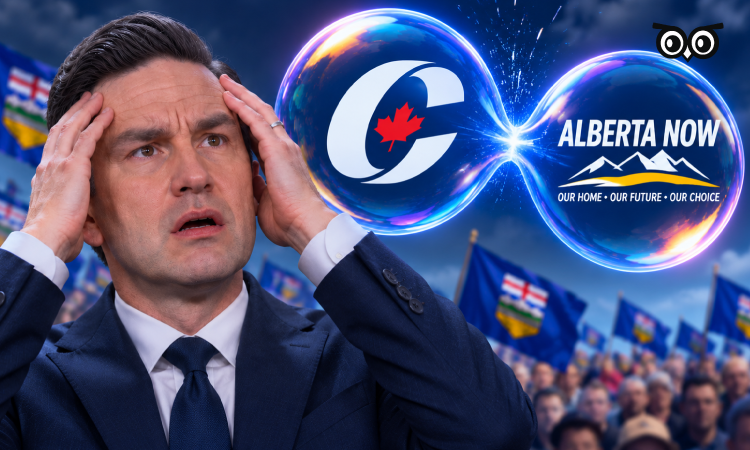
Conservative Party Leader Pierre Poilievre has an unenviable position. On the one hand, Ottawa is increasingly a one-party imperial city under Prime Minister Mark Carney and the Liberals. On the other, Poilievre has declining popularity and the impossible task of winning over Laurentians while retaining the Prairies.
Plainly, the Conservative Party suffers from a dual mandate that will be its undoing: (1) achieving federal electability and funding from special-interest patronage and (2) maintaining the party under a pan-Canadian banner.
These two mandates are at odds, and the chasm is widening by the day. No one can serve two masters, and the dam cannot hold. The trickle of Albertans toward a provincially oriented party will turn into a river.
In the wake of the independence referendum, patriots see the Conservative Party harming provincial autonomy and playing Albertans for fools. This leads to one conclusion: the time is right to take a new tack, especially since the federal Conservatives are electorally impotent against the Liberals. When more influence is to be found via targeted provincial demands, why bother with the Conservatives?
Albertans have crossed the Rubicon with their grievances, as became clear in the lead-up to the October 19 referendum. All 33 Conservative members of Parliament from Alberta campaigned against a binding independence question, along with the four MPs from the Liberal and New Democratic parties. The Conservatives could have remained neutral or supported a prudent bargaining chip, but they adamantly did not.
Further, Poilievre gave a deceptive 18-minute speech at the Strong & Free event on October 16 in Calgary. He had zero to say on Equalization or constitutional changes, and his sophistry signaled tied hands. He also belittled Alberta nationalists as lazy and cowardly, when the reality is the opposite. All Poilievre could offer was hollow rhetoric that likely even he did not believe. Talk of Canada as the “promise of freedom” and a united people has become sadly laughable. David Wiechnik of the Western Standard reported a mixed reception at best.
An Alberta journalist and “concerned patriot” who works under the Honkamaniac pen name shared that the Poilievre speech was infuriating: “He alluded to linking arms with our fellow Canadians—that we need to continue the cause of freedom and celebrate the freedom that we have. What freedom? What identity are we celebrating? I am not seeing any freedom, and I am not seeing any actual results.”
With many years out of power and a knack for losing, is the Conservative Party relevant anymore? “Not in Alberta,” Honkamaniac responded. “I have seen this ‘fiscal conservative’ nonsense … that ‘we are the party of John A. MacDonald.’ MacDonald would be rolling in his grave with the party as it is now.”
The success of the Bloc Québécois in championing provincial interests in Ottawa has offered inspiration and a proven path forward for Alberta and Saskatchewan. While the Bloc suffered electoral setbacks in the 2010s, the party is riding high on dissatisfaction with Ottawa, and Prairiemen have noticed.
Given a likely three years until the next federal election—there could be by-elections sooner—there is time to build the campaign and identify qualified candidates. Alberta Now has surpassed 500 membership signatures and is ready to register with Elections Canada. (The minimum is 250.)
Any success in Alberta will spread like wildfire to Saskatchewan as the neglected Conservative base finds a more fruitful path. Likely, there will be a Saskatchewan equivalent in short order, perhaps under the Buffalo Party or Sask United branding or as a coordinated Sask Now partner. The former two are registered provincial parties right now.
Alicia Rhae, a prolific advocate for Saskatchewan sovereignty, is “disappointed to hear that the new federal party, Alberta Now, is just for Albertans.” She and her kin do not want to be left out: “A lot of us here are so emotionally invested in what happens there. We were all rooting for Alberta independence to succeed given the results would effect what happens here profoundly. Saskatchewan MPs would probably end up sitting together with Albertans in the House of Commons anyway. Note: of the top 10 most conservative ridings in Canada, four are in Saskatchewan, including the top one.”
Former Alberta provincial legislator Drew Barnes, who represented Cypress-Medicine Hat for the Wildrose and United Conservative parties, is putting his reputation on the line to build Alberta Now. The push is for sovereignty and an Alberta voice, rather than being left or right or for or against independence. That fits with his highest-profile backer to date: Tamara Lich. Originally from Saskatchewan, she has been coy about independence, but she is for decentralization away from Ottawa.
Barnes was booted from the UCP by then Premier Jason Kenney—a badge of honour—and has gravitas as an independent-minded legislator. Presumably, Barnes hopes to attract past Liberal and NDP voters who favor local governance. Breaking ideological and partisan lines would be a game changer and make Alberta Now a more formidable force.
A recalibration is in the offing as parliamentarians flee the sinking Conservative ship. The spread of Bloc-style parties across Canada can bring profound changes to policies such as immigration, First Nations funding, and even Canadian content laws. Ideally, Ottawa will be cornered into aligning policies towards each province’s needs and retreating to enable provincial self-governance and stronger regional identities.


