
A.G. Richey, a major 19th-century Irish historian, is hardly visible to us despite his originality. Something he said 160 years ago was fresh at the time and is fresh today.
At the start of a lecture to students of Alexandra College, Dublin, Richey said: “Thoroughly to appreciate the history of this or any country, it is necessary to sympathize with all parties—to understand their prejudices, their difficulties, and their errors.”
It’s a striking, challenging, energizing statement. As one devoted to his nation’s history, Richey knew about the need to sympathize with all. His formula brooks no exception.
We in the United States today are standing at a dangerous pivot in our history. We desperately need the kind of understanding that Richey proposed. That doesn’t only mean an understanding of our external enemies. It means, more formidably, an understanding to extend toward those in our own society whom we would rather destroy.
A central figure in our domestic disputes is Thomas Friedman, who is good at getting into the thick of things. He is almost more of a diplomat than a journalist. What he says, he says with stature.
In a recent video interview, Friedman said that while the Iranian regime represents evil, Donald Trump and Benjamin Netanyahu embody evil at its most extreme. Friedman said he will not use his platform on behalf of those leaders. In effect, he refuses to help the evil he knows.
From that assertion, Friedman’s talk took an interesting turn. He said his choices have landed him in a moral dilemma. He showed his feelings, thereby departing from diplomatic practice. He confessed he felt smaller than the dilemma he is facing.
So it happened that, if only for an instant, a member of the policy elite became one of us.
After that performance, it almost doesn’t matter what choice Friedman makes. It’s time to extend the Richey dictum in Friedman’s favor. More than simply parading his ideas, he has shown his doubts. That is sincerity of a high order.
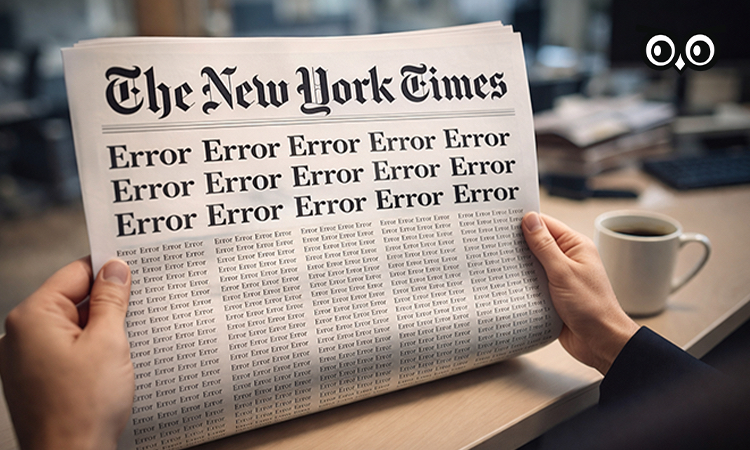
No such positive feeling extends to Friedman’s institutional home, the New York Times. Among other things, the paper is headed for a collision with historical reality because, in 70 years of covering Cuba, the Times has never outgrown its infatuation with Cuba’s oppressive socialism. That stubbornness combines with the paper’s lofty conceit about itself. In its own words: “The New York Times does not make mistakes.”
Friday, April 3, 2026 was a banner day for those of us who believe that US news media, beginning with the Times, are badly broken. On that day the Times published a news analysis under a banner headline on an inside page. The headline read: “A North American Treaty Organization without America?”
North American Treaty Organization? That phrase was a piece of nonsense. The correct phrase was, and still is, the North Atlantic Treaty Organization.
The problems were just beginning. The subject was NATO, and the writer did not even know the acronym. Probably, the article’s text was also fouled. It wasn’t just the headline. They would have to pitch the article, too.
Why did not someone get this right before publishing it?—because now, the editors were reading this filth on their published pages.
They were frantic to rub out the bad texts. Who could blame them? Every minute the errors were being viewed by thousands more. All those erroneous views! And President Trump himself was chiming in. He was saying the American media are full of stuff like this.
The Times had to act at once. Someone issued a statement saying a correction would appear tomorrow. What they really had to do was to put something else before the public. They would create a new headline and article. What about the bad texts from April 3? They would become hard to find. Not impossible—but the process would discourage people.
And lo and behold, that’s how they did it. On April 4 the Times issued a new headline and text. The only commonalities with the old texts were the writer’s byline and the North Atlantic … What did you say?
Nothing! We do not make mistakes, we wash them away.

As memories of the great error fade, so will the Times’s ancient prerogatives. The United States has a tradition of freedom 250 years old. Our free-and-brave journalism will function much more nicely without a central institution like the Times putting its two cents in.
Thanks to the cock-ups of April 3 and 4, the paper of record is becoming a paper tiger. And our independent journalists are gaining the impetus to build up a new world of writing that they may contribute to the rising tide of liberty.


