
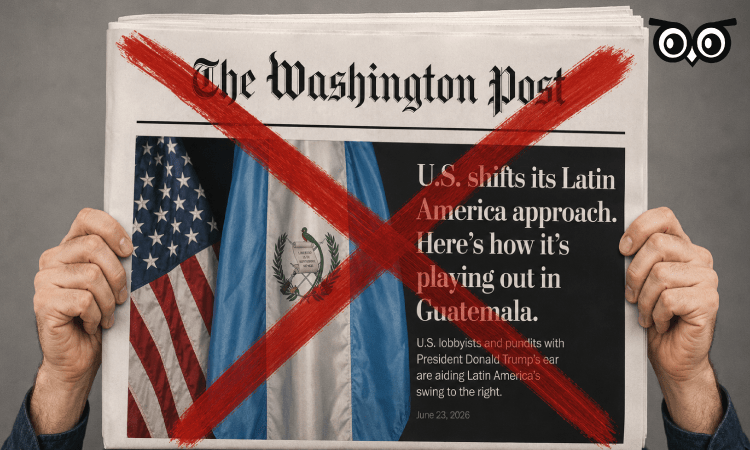
A recent Washington Post article misrepresents efforts by representatives of Guatemala’s organized private sector (OPS) to engage the Donald Trump administration. If one believes the Post‘s portrayal, there is a shadowy plot to engineer a rightward turn in opposition to the current Guatemalan government, headed by President Bernard Arévalo.
Both the original piece and its local replications are weak on facts and heavy on insinuation. Their intent is to frame routine diplomatic and commercial outreach as something sinister. Meanwhile, they ignore the far larger, taxpayer-funded influence operations long run by the left to promote various causes of questionable value to US and Guatemalan interests.
What the Trump administration has asked of Guatemala is mutually beneficial: more cooperation in the fight against narcotics and illegal immigration and to reduce dependence on China. These asks largely align with Guatemala’s own security and economic needs, as Arévalo has noted.
Contrary to what the Post article implies, President Trump’s team has not shown hostility towards the Arévalo government. The article itself admits that relations are described by the present State Department (DOS) spokesman as “positive and productive.” Nonetheless, the intent of the framing of the Post article was to paint any pragmatic engagement with the Trump administration as nefarious.
The $400,000 in lobbying expenditures by the Guatemalan private sector that the Post reports is framed as evidence of undue influence. However, in Washington, DC, that sum would barely cover the salary of a president of a left-wing NGO.
More important, this funding is private and subject to US disclosure rules under the Foreign Agents Registration Act, FARA. Contrast this with the permanent funding and personnel infrastructure the left has maintained for years: former DOS officials, CICIG alumni, USAID programs, Freedom House, WOLA, Seattle International Foundation, Human Rights Watch, Oxfam, Vital Voices, and the Ford Foundation.
These leftwing actors, funded directly or indirectly by US taxpayers, have for years shaped narratives attacking both the Trump administration and the Guatemalan business sector in media outlets such as the New York Times, the Washington Post, the Economist, and aligned Guatemalan media. The talking points originate in those networks and are then amplified locally. This pattern of a one-sided information flow never addresses facts that contradict the preassigned narrative.
The WOLA representative in Guatemala went so far as to post on X that the lobbying firm in question, Corcoran Partners, represents “networks of organized crime.” This a serious accusation with no evidence behind it, a scurrilous charge that could constitute grounds for a defamation action.
In the end, the Post article rests on at least three inaccuracies. First, it claims the Guatemalan private sector has waged “withering attacks” on the Arévalo government. The record shows otherwise. Shortly after the 2023 elections, Guatemala’s Chamber of Industry presented President-elect Arévalo with the “Guatemala Moving Forward” plan. This was a private-sector roadmap for expanding Guatemalan trade and investment.
Subsequently, when rumors circulated that the electoral results might be contested, the OPS publicly called for respect of the official outcome. There is literally no evidence of any “withering attacks” by the Guatemalan OPS against the Arévalo government.
Second, the article implies tension between the Trump administration and the Arévalo government, despite citing Secretary of State Marco Rubio’s characterization of the US-Guatemala relationship: “We are not only neighbors, we are allies, we are friends.” Other DOS officials, as noted by the Post, categorized current bilateral ties as “positive and productive.” These are not the words of a hostile administration.
Third, the piece suggests that private-sector lobbying is steering US policy toward Guatemala. US foreign-policy adjustments under the second Trump term flow from a coherent strategic decision by Rubio, who wrote in a Wall Street Journal Op-Ed:
“It’s no accident that my first trip abroad as secretary of state, to Central America on Friday, will keep me in the hemisphere. This is rare among secretaries of state over the past century. For many reasons, US foreign policy has long focused on other regions while overlooking our own.”
Under Rubio, the DOS published an X post critical of DOS and USAID officials who had grown accustomed to advancing personal or politicized agendas disconnected from core US interests. As Rubio bluntly stated in his Senate testimony last May, “The State Department had to change.”
It would surprise no one if former officials were among the anonymous sources for the Post story. Critics of Arévalo named by the Post—such as Laura Loomer, Michael Flynn, or Roger Stone—do not hold positions in the Trump administration. As the Post story itself acknowledges, Stone stated he has never discussed Guatemala with the president or any member of the administration. In the end, guilt by association is not evidence of policy capture.
What remains after these corrections? Little else besides recycled alarm about Guatemalan business leaders legitimately seeking commercial and diplomatic space. That is especially relevant in a changing DC environment in which nearshoring offers tremendous win-win opportunities for the United States and its regional partners.
Guatemala faces many challenges, including corruption, institutional weakness, narcotics flows, and strategic competition with China. These challenges will not be solved by maintaining the informational monopoly once enjoyed by a narrow set of former DOS officials, left-wing international NGOs, and legacy media outlets.
The Guatemalan private sector’s engagement with the United States is a legitimate action. They have reached out to a new administration whose stated priorities on security and supply chains overlap with Guatemala’s long-term interests.


