
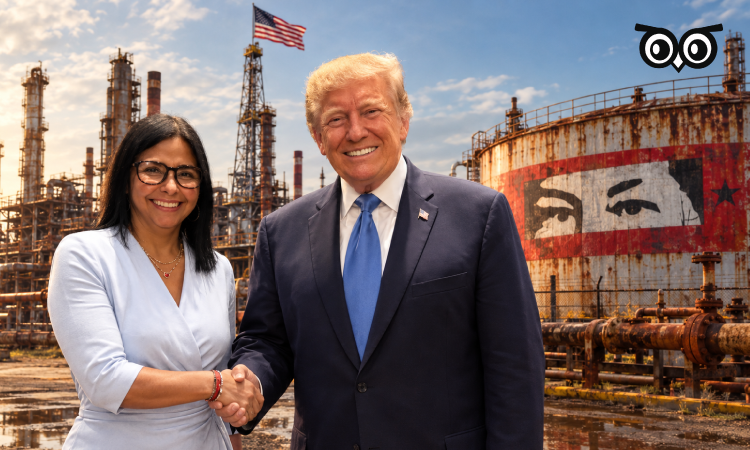
On August 28, 2026, US President Donald Trump announced a bilateral agreement with Venezuela, following negotiations with the heirs of the dictatorship. As a result, private firm North American Blue Energy Partners (NABEP)—whose owner amassed a fortune during the Chavista era—will control approximately 20 percent of Venezuela’s total oil reserves.
According to the White House, the agreement will support the recovery of Venezuela’s oil industry and overall economy, thereby securing the path toward democracy. The argument is appealing: Venezuela needs capital, technology, and expertise to rebuild a devastated economy, further deteriorated by the earthquakes in June.
However, the devil lies in the details. The agreement was negotiated in secret, without the participation of the Venezuelan opposition or the US Senate. This lack of transparency and legitimacy casts serious doubt on the agreement’s legal viability and its potential benefits for Venezuelans.
1. The US-Venezuela oil deal stands on quicksand.
Trump described the oil deal—covering 17 oil fields or approximately 65 billion barrels—as “the biggest in world history.” Under the terms reportedly outlined, the Pentagon’s Office of Strategic Capital (OSC) will have a 35 percent stake, veto power, and preferential access to Venezuelan crude for up to 100 years.
The Venezuelan regime, however, claims the license will only last 25 years. This discrepancy is evidence of the legal uncertainty surrounding the purported agreement.
Furthermore, the head of the Barbados-based company NABEP is Alejandro Betancourt. He was awarded multibillion-dollar electricity contracts at the discretion of former Venezuelan President Hugo Chávez. Investigative outlets such as the Organized Crime and Corruption Reporting Project (OCCRP) have identified those projects as key ingredients leading to the energy crisis in Venezuela. Betancourt has also been investigated for money laundering in Switzerland, Spain, and the United States.
Venezuela’s oil sector is a risky investment with limited prospects for profitability. On the one hand, Venezuela’s oil industry requires billions of dollars in investment to bring production facilities back to operational capacity. According to Francisco Monaldi, director of the Latin America Energy Program at the Baker Institute in Rice University, rebuilding the oil-exploitation infrastructure to its peak levels of the 1970s would require companies to invest about $10 billion per year over the next decade.
On the other hand, the extra-heavy crude Venezuela produces is more costly and technically demanding to refine. Many US refineries in Texas and Louisiana are designed to process the type of heavy crude Venezuela produces. So far, however, only Chevron has shown interest in the project. “For any oil companies to actually get serious about investing in Venezuela would require that there will be a new congress or National Assembly,” Lino Carrillo, a former manager at state-led oil company PDVSA, told Bloomberg.
Moreover, Monaldi argues: “The past seven decades of Venezuela’s oil industry are marked by broken contracts and resource nationalism. No agreement has survived to maturity without significant deterioration of terms.” A century-long agreement, therefore, requires a solid legal framework at a minimum. Moreover, given the alleged transition period, any future government could challenge the agreement, considering no legitimate member of the opposition was present during negotiations.
2. US interests cannot replace Venezuelan interests.
Following the military operation that overthrew dictator Nicolás Maduro in January 2026, the Trump administration assumed control of Venezuela’s oil revenues, with the stated objective of pressuring the country toward a democratic transition. However, the White House later asserted Venezuela is not yet ready to return to the polls, while praising Delcy Rodríguez as a highly respected leader who is doing a fantastic job.
As the United States faces an increasingly difficult situation—with the war in Iran and fuel prices rising as a result—Washington’s strategy towards Venezuela appears to be shifting. Venezuela’s oil production could become a major political achievement amid the campaign.
According to YouGov polling data released by the Economist, Trump’s approval rating is at historic lows. As of September 22, 61 percent of US citizens disapprove of his performance, while 35 percent approve. Ravi Agrawal, editor-in-chief of Foreign Policy, asserts Trump has reached his peak powers and begun his decline. This trend points to growing political challenges for Republicans, which could result in a defeat in the November 3 midterm election.

3. Venezuela needs institutional reform, not only oil investment.
The United States has legitimate interests: energy security, reducing the influence of Russia and China, and restoring a strategic industry in the Western Hemisphere. Trump has stated that US control over Venezuela’s reserves will help lower fuel prices and ease the burden on US consumers ahead of the midterm election. Short-term political interests, however, should not put Venezuela’s democratic future at risk.
If Washington truly wants a stable and prosperous Venezuela, it should understand that the best guarantee for its own interests is not to confer legitimacy on Chavismo and entrench it in power. The best path forward is a transition that allows a democratic government to provide legality, transparency, and legal certainty to any oil agreement.
Capitalism requires private property and foreign capital, but it also requires transparent contracts, competition, independent courts, and predictable rules. If attracting investment requires replacing Venezuelan institutions with Washington’s political and corporate protection, then what is being built is not a free and competitive market but an imperial economic zone under geopolitical tutelage.


